How a Benchtop Filament Extruder Works, From Pellets to Spool
The four stages inside a filament extruder, feeding, melting, cooling and spooling, and what each one means for the filament you print with.
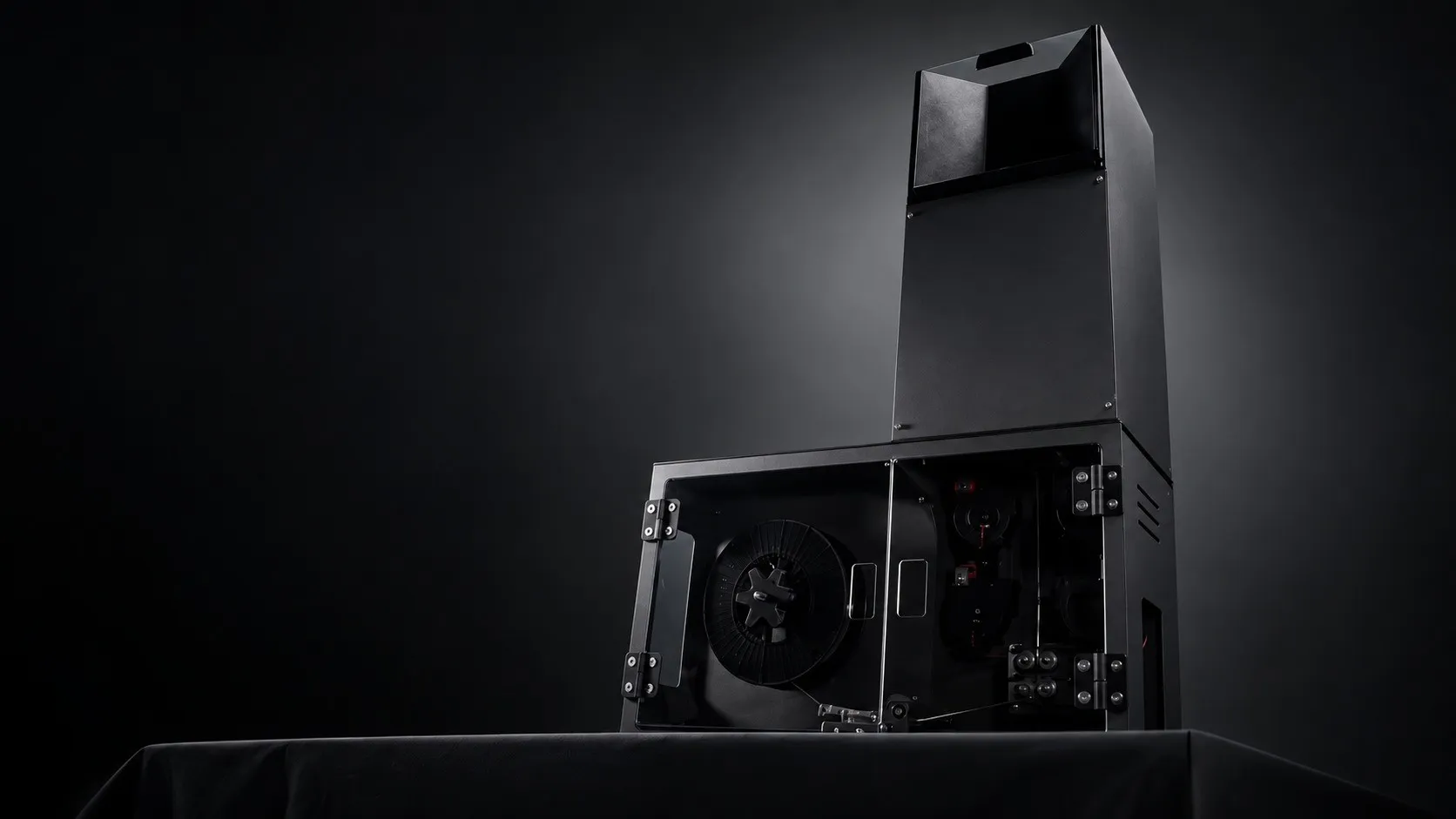
A filament extruder feeds thermoplastic pellets into a heated barrel, where a rotating screw melts, compresses and mixes them. The melt is pushed out through a die, cooled by air, measured for diameter and wound onto a spool. ASTER-C does all four stages in one benchtop cabinet, up to 450°C.
Key takeaways
- Every extruder has four stages: feeding, melting and mixing, cooling, and measuring and spooling.
- The screw does most of the work. Its zones feed, compress, meter and mix the polymer.
- Diameter is controlled after extrusion, by measuring the cooled strand and adjusting the pull.
- ASTER-C extrudes vertically, so gravity helps the strand down instead of fighting it.
- Thermosets and PVC cannot be extruded on ASTER-C.
A filament extruder turns thermoplastic pellets, granules or reclaimed material into the continuous strand a 3D printer feeds on. Industrial lines do this across several metres of equipment. A benchtop extruder like ASTER-C does it in one cabinet. The process has four stages.
1. Feeding
Material goes into the hopper. On ASTER-C the hopper holds more than 2.5 litres. This is also the point where you add anything you want blended into the base polymer: fillers, reinforcements, colourants or additives.
From the hopper, material drops into the feed section of the screw. Consistent feeding matters. Pieces that are too large or irregular can bridge in the throat and starve the screw, which shows up later as diameter variation.
2. Melting and mixing
A rotating screw carries material forward through a heated barrel. As it travels, the polymer softens, compresses and melts. ASTER-C’s screw is EN41B steel, nitrided and chrome plated, 340 mm long with a 25 mm maximum diameter, driven by a stepper motor at 0–100 RPM. The barrel is case hardened.
The barrel is divided into four heating zones, each with its own job:
| Zone | What it does |
|---|---|
| Feeding | Moves solid material forward from the hopper |
| Compression | Squeezes and melts the polymer, driving out trapped air |
| Metering | Delivers a steady, uniform flow of melt |
| Mixing | Distributes fillers and additives evenly through the melt |
The mixing zone is what makes composite blends possible. Without it, fillers tend to clump and the filament comes out with weak spots.
3. Extrusion and cooling
The melt is pushed out through a die. ASTER-C extrudes vertically, so gravity helps carry the strand down rather than pulling it sideways off line.
Cooling sets the strand’s shape. ASTER-C uses air cooling from PWM-controlled fans, and fan speed is adjustable in the control software. Different polymers need different cooling: too fast can introduce stress, too slow lets the strand sag or ovalise.
4. Measuring and spooling
After cooling, the strand passes between drive rollers that pull it at a controlled speed. Pull speed relative to extrusion speed is what sets the final diameter: pull faster and the strand thins, slower and it thickens.
A Hall-effect sensor reads the diameter of the pulled strand to within ±50 µm. Diameter is user-definable anywhere from 0.5 mm to 3 mm, with 1.75 mm and 2.85 mm the typical sizes for 3D printers. The finished filament is wound onto a spool of up to 3 kg, held on a magnetic spool holder.
What it cannot run
Thermosets and PVC are not compatible with ASTER-C. Thermosets cure irreversibly and will not re-melt, so they pack cured material into the barrel. PVC releases corrosive decomposition products at extrusion temperature that attack the screw and barrel. Neither is covered by the warranty.
What you need to run it
ASTER-C runs on a standard single-phase 230 V, 50 Hz supply, drawing about 1500 W at peak. It weighs 35 kg and measures 250 × 590 × 910 mm, so it fits on a bench in the room where the work happens. You will also need a Windows PC for the control software, which logs each run to CSV.
Frequently asked questions
What temperature does a filament extruder need?
It depends on the polymer. Commodity grades process at lower temperatures, while engineering polymers need much more heat. ASTER-C runs from room temperature up to 450°C across four heating zones.
What goes into a filament extruder?
Extrusion-grade thermoplastic pellets or granules, and optionally fillers, reinforcements, colourants or suitable recycled material blended into the base polymer.
How is filament diameter controlled?
On ASTER-C, a Hall-effect sensor reads the diameter of the pulled strand, holding accuracy to ±50 micron. Diameter is user-definable from 0.5 mm to 3 mm.
Do I need a computer to run ASTER-C?
Yes. ASTER-C is controlled from a Windows PC GUI with CSV data logging. The PC is not included.