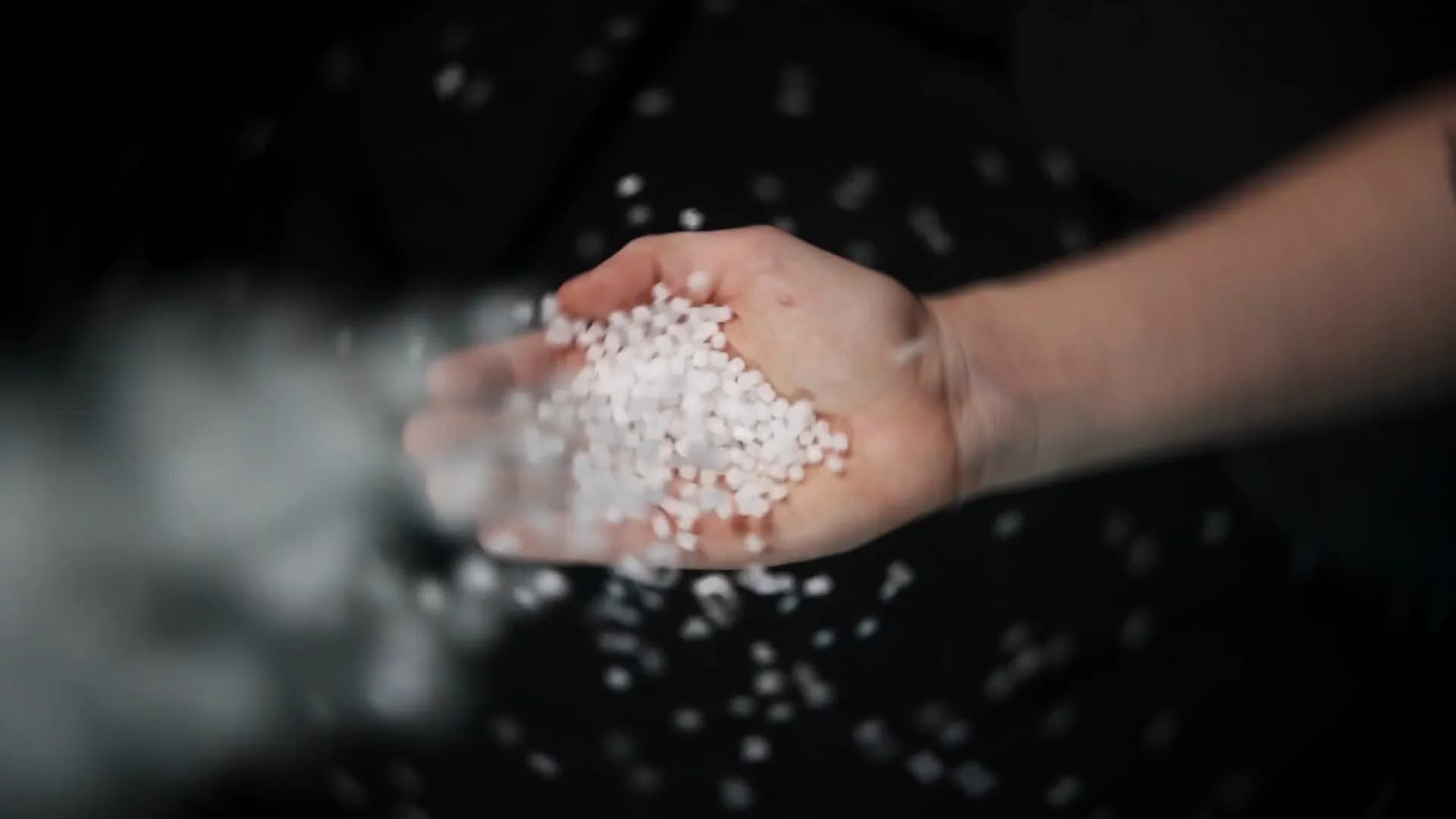
Filament, on your own terms
The material your work needs often is not sold — not in that grade, that blend, that diameter, or that quantity. ASTER-C is a 450°C tabletop extruder that lets you make it yourself, on your own bench, the week you need it.
Your material should not be someone else's decision
You already know what you want to run. A high-temperature grade with a specific filler. A recycled batch that only exists in your own workshop. An unusual diameter. A colour nobody stocks. The formulation is not the hard part — getting it as filament is.
So the work slows down. You request a quote and wait a fortnight. You are told the minimum order is 50 kg when the experiment needs two. You substitute a material you did not want, and the result no longer answers the question you were asking. Meanwhile the process scrap in the corner — material you already paid for — goes to waste.
What that actually costs
Research cycles measured in supplier lead times instead of bench hours.
Money spent on minimum order quantities for material you will barely use.
Formulations you never test, because testing them is not worth the wait.
Reclaimable scrap thrown away for want of a way to process it.
We have been on your side of this
Printgloo Technologies builds ASTER-C at our facility in the Jigani Industrial Area, Bangalore. We built it because we kept hitting the same wall ourselves. Five early adopters are running the machine in the field right now, and every number on this site comes from its specification sheet and operating manual — not from a brochure.
Who ASTER-C is for
Four kinds of workshop keep hitting the same wall. If one of these is yours, the rest of this page is written for you.
Technology R&D
Test high-performance polymers on your own schedule instead of waiting on industrial supplier lead times for every new formulation. The machine reaches 450°C, so the engineering grades are in range.
Specialty Manufacturers
Produce small batches of custom-blended composite filament in-house, at the volumes a contract supplier will not quote for. The screw's mixing zone is what disperses fibre and powder instead of streaking it.
Schools & Maker Labs
Teach extrusion as it actually works — four heating zones, a real auger screw and live diameter data — on a machine that fits on a bench and runs off a normal single-phase supply.
Industrial Recyclers
Close the loop on print waste and process scrap, turning recovered thermoplastic back into usable engineering filament at a diameter you define.
How this works
Three steps, and the first one costs you nothing but an email.
1. Tell us what you need to extrude
Your base polymer, your filler, the diameter you print at. If ASTER-C is the wrong machine for it, we will say so.
2. We extrude a sample from it
We run your combination and send you the filament, so you are judging the result in your own printer rather than trusting a datasheet.
3. Bring it in-house
The machine arrives, sits on a bench, runs off single-phase 230 V, and from then on the material decision is yours.
Start with the sample, not the machine
Send us the polymer and filler you want to run. We will extrude it and post it to you, before you spend anything.
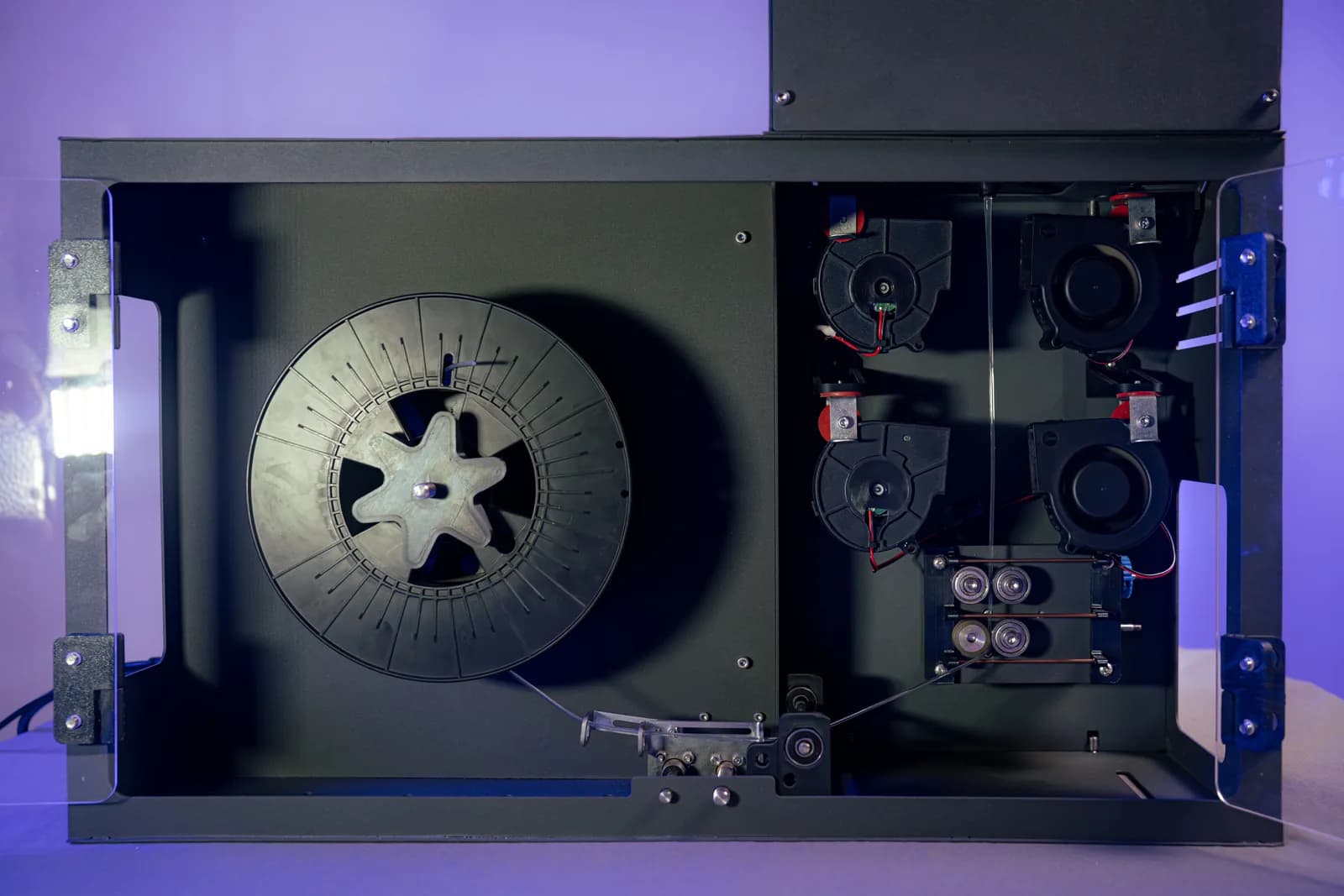
Vertical extrusion, air cooled, on a bench that fits in the room where the work happens.
What you can run through it
An open material system: the machine sets the temperature and the tolerance, and you decide what goes in the hopper.
Extrusion-grade thermoplastics
Any extrusion-grade, non-corrosive thermoplastic, anywhere from room temperature up to 450°C across four independently managed heating zones.
Fillers and reinforcements
Carbon fibre, glass fibre, metal powders, natural fibres, additives, colourants and surfactants — the mixing zone in the screw is what makes composite blends work.
Recovered and recycled feedstock
Reclaimed thermoplastic from print waste or process scrap, extruded back into filament at a user-defined diameter between 0.5 mm and 3 mm.
Not compatible — thermosets and PVC
Strictly no thermosets and strictly no PVC. Thermosets cure irreversibly and will not re-melt, so they pack cured material into the barrel. PVC releases corrosive decomposition products at extrusion temperature that attack the screw and barrel. Neither is covered by the warranty.
Compatible materials
Everything below is drawn from the ASTER-C specification sheet. A base polymer, plus any of these, blended by the screw’s mixing zone.
- Carbon fibreReinforcement
- Glass fibreReinforcement
- Metal powdersDensity, conductivity
- Natural fibresBio-loaded blends
- AdditivesFlow and stability
- ColourantsPigment
- SurfactantsSurface and dispersion
- Recycled stockPrint and process scrap
Questions before you commit
Which materials can ASTER-C extrude?
All extrusion-grade, non-corrosive thermoplastics. On top of the base polymer you can run filler materials: carbon fibre, glass fibre, metal powders, natural fibres, chemical additives, colourants and surfactants.
The screw's specially engineered mixing zone is what makes this work — it is the reason ASTER-C handles composite blends and recycled polymer rather than only virgin single-grade feedstock.
What can it not run?
Strictly no thermosets, and strictly no PVC.
Thermosets cure irreversibly and will not re-melt, so they cannot be extruded — attempting it packs cured material into the barrel. PVC releases corrosive decomposition products at extrusion temperature that attack the screw and barrel. Neither is covered by the warranty.
How is filament diameter controlled?
Diameter is user-definable anywhere between 0.5 mm and 3 mm, which covers the common 1.75 mm and 2.85 mm printing standards and everything between.
Measurement is mechanical: a Hall-effect sensor reads the gap between two rollers that physically contact the filament, giving accuracy within 50 microns. A second set of rollers below it, driven by a stepper motor, pulls the strand — puller and spooler speed tune automatically, with manual override available.
How is the screw built?
A single screw, 340 mm long and up to 25 mm in diameter, in EN41B steel that is nitrided and chrome plated. The barrel is EN41B case hardened. It turns at 0 to 100 RPM on a stepper motor drive.
How is the machine controlled, and is a PC included?
Through a GUI running on a Windows PC. The PC is not quoted as standard with the machine and must be arranged by the user.
The GUI sets the temperature of each zone, screw RPM, and the PWM intensity of the cooling and hopper fans. A logging toggle records extrusion data to a CSV file you can open after the run. Further firmware updates to improve data access are planned.
What does it need to run?
A single-phase 230 V 50 Hz supply, drawing around 1500 W at peak, and roughly 250 × 590 × 910 mm of bench space. The machine weighs about 35 kg.
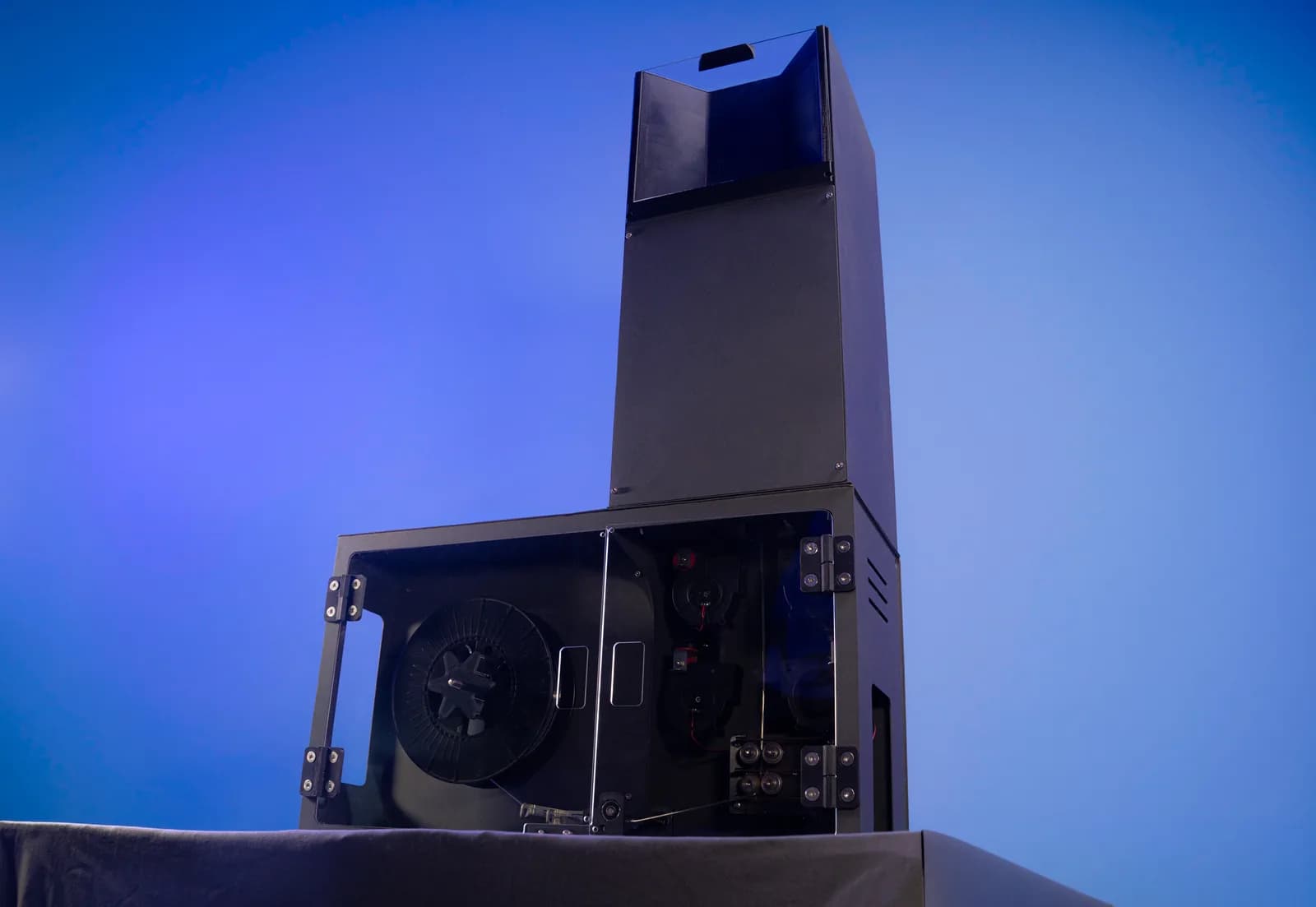
Hopper holds more than 2.5 litres of feedstock.
Collet-type spool holder takes spools over 3 kg.
Filament is extruded vertically and air-cooled on the way down.
Run the material you actually wanted
No minimum order. No fortnight of waiting. No substituting the grade you can get for the grade you needed. The formulation is decided at your bench, and the scrap in the corner becomes next week’s spool.
Get in touch
Tell us what you want to extrude and we will come back to you with pricing, a lead time, or a sample — whichever you need. We aim to reply within one business day.
Phone
Address
Printgloo Technologies Pvt. Ltd., Jigani Industrial Area, Second Phase, Bangalore, Karnataka, India