How ASTER started
ASTER began as an internal workaround, not a product. Printgloo Technologies was doing applied work with advanced polymers in Bangalore, and the same obstacle kept appearing: the moment a project moved past commodity material, the filament simply was not available to buy — not in that grade, not with that filler, not at that diameter, and never in the quantity a test actually needed.
The workarounds were all bad. Substitute a material and the experiment answers a different question. Order the minimum quantity and most of it sits on a shelf. Wait for a quote and the project waits with it. And in every workshop there was usable thermoplastic — failed prints, purge, process scrap — being thrown away because there was no practical way to turn it back into filament.
Building the machine we needed
So we built an extruder for ourselves. The requirements came from the problem rather than from a category: it had to reach the temperatures engineering polymers need, disperse fillers properly instead of streaking them, hold a diameter tight enough to print with, and be small enough to live in the room where the work happens.
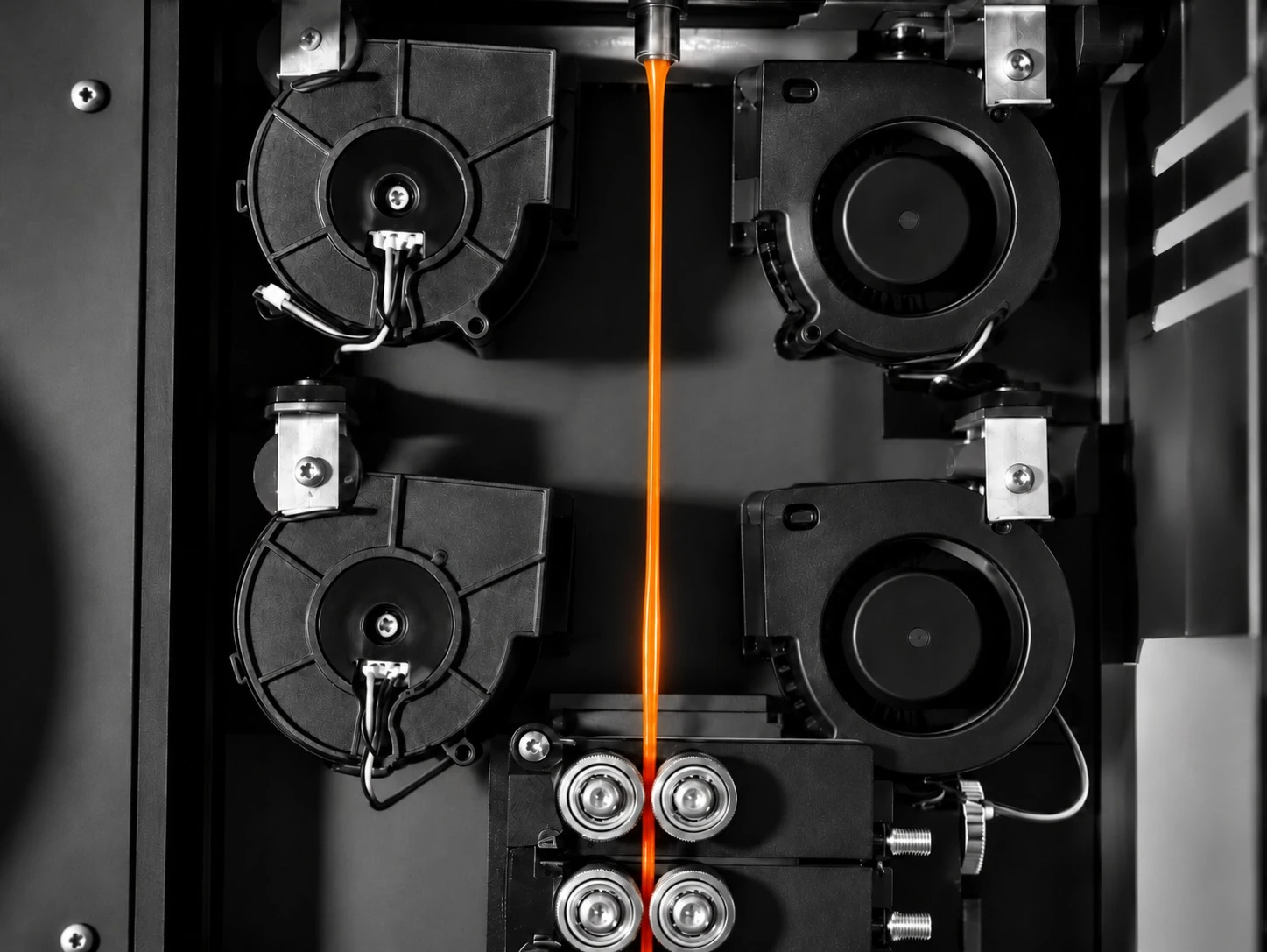
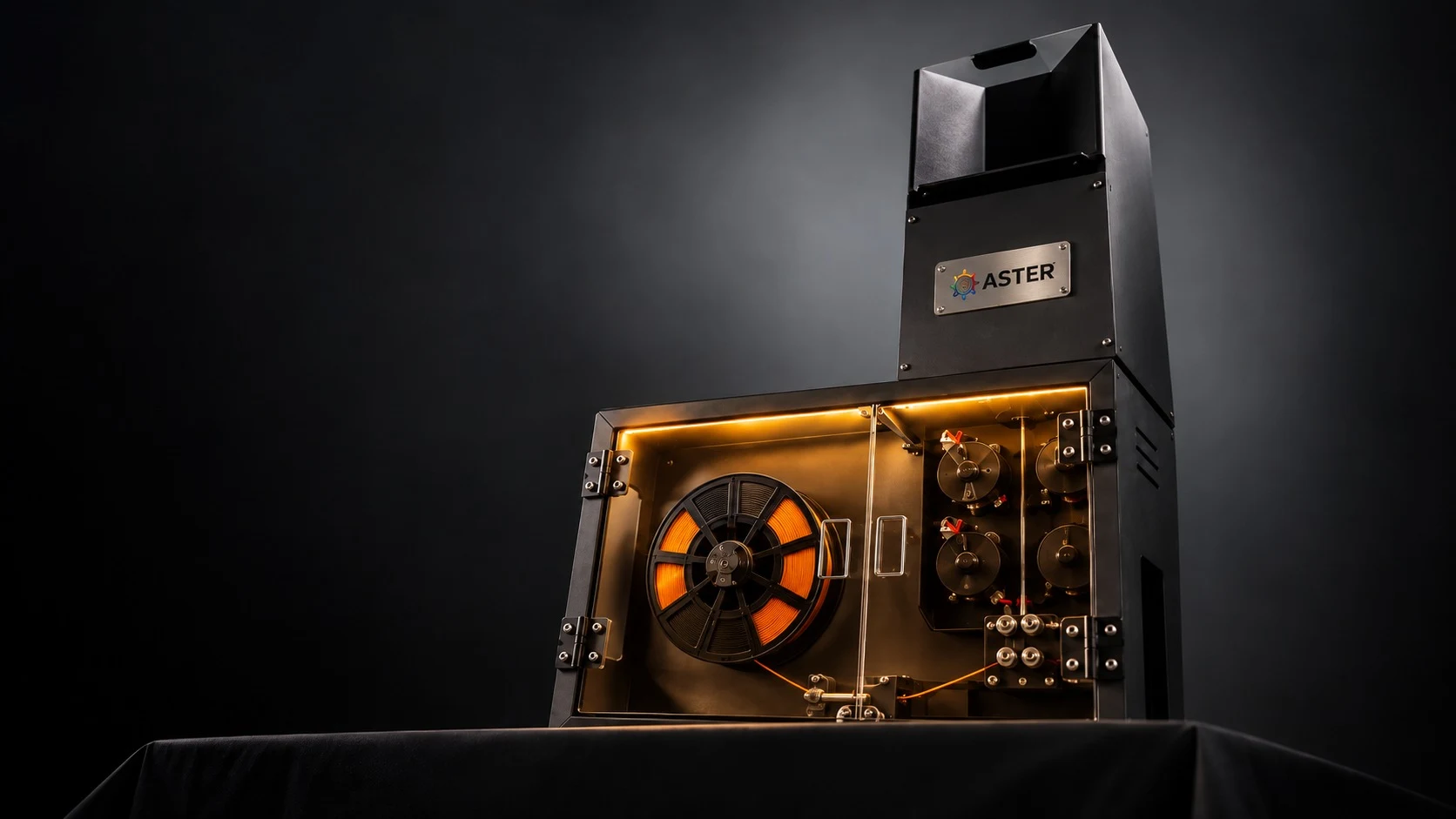
That produced the decisions ASTER-C still carries. A single screw with a specially engineered mixing zone, because composites were the point from the beginning. 450°C across four independently controlled zones, because the high-temperature grades were the ones we could not buy. A Hall-effect sensor physically measuring the strand as it is pulled, because a diameter you cannot verify is not a specification. And a tabletop footprint on a normal single-phase supply, because a machine in another building does not get used.
What ASTER means
ASTER stands for Advanced System for Thermoplastic Extrusion and Recycling. The recycling half is not a marketing addition — it was in the brief from the start, because the scrap problem and the availability problem are the same problem seen from two ends.
Where it is now
ASTER-C is in field testing with five early adopters, who are running real material through it and telling us what breaks. Everything published on this site — every temperature, dimension and tolerance — comes from the machine's specification sheet and its operating manual, because those are the documents those users are actually holding.

The team behind it
ASTER-C is designed, built and supported by Printgloo Technologies Pvt. Ltd. at our facility in the Jigani Industrial Area, Second Phase, Bangalore, Karnataka. The machine is assembled and tested in the same building it was designed in, which is why the people who answer a support question are the people who built the part in question.
PLACEHOLDER — replace this paragraph with the actual team. Names, roles and a line each on what they own: mechanical design, electronics and firmware, materials and process, and customer support. This section is deliberately left unwritten rather than invented, because the whole point of an about page is that it is true.
Talk to us directly
Printgloo Technologies Pvt. Ltd., Jigani Industrial Area, Second Phase, Bangalore, Karnataka, India
sales@printgloo.com
+91 7259 36 6707

Ready to make your own filament?
Tell us what you need to extrude and we will get back to you with pricing, a lead time, or a sample.